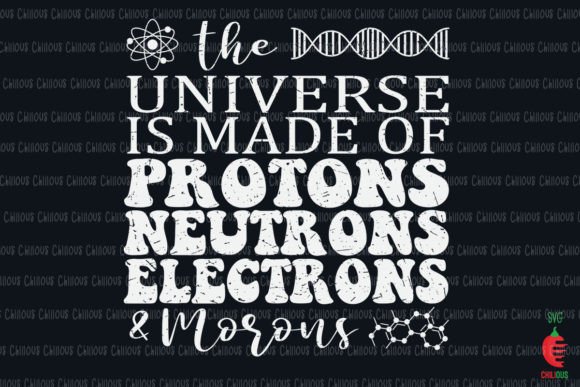
Universe is Made of Protons Neutrons... Explained
The phrase "Universe is Made of Protons Neutrons..." refers to a concept that explores the fundamental building blocks of matter. At its core, this idea highlights the role of protons and neutrons in forming atomic nuclei, which are essential components of all elements in the universe. Understanding this concept can be particularly useful for educators, students, and anyone interested in the basics of chemistry and physics.
What is Universe is Made of Protons Neutrons...
"Universe is Made of Protons Neutrons..." is not a specific product or service but rather a scientific concept that describes the composition of matter at the most basic level. Protons and neutrons are subatomic particles found in the nucleus of an atom, while electrons orbit around them. This framework is crucial for understanding how different elements interact and form the materials that make up our world.
For science teachers, especially those preparing for the first day of school or looking for creative ways to engage students, this concept can serve as a foundation for lessons on atomic structure, chemical reactions, and the periodic table. It also offers a way to connect abstract scientific ideas with real-world examples, making learning more relatable and engaging.
Why Someone Might Be Interested in This Concept
There are several reasons why someone might be drawn to the idea of "Universe is Made of Protons Neutrons...". For educators, it provides a clear and concise way to introduce complex topics like atomic theory and nuclear physics. It can also be a valuable tool for teachers who want to incorporate visual aids into their lessons, such as SVG files, PNGs, or DXF designs, which can help illustrate these concepts in a more interactive manner.
Additionally, this concept appeals to those who are passionate about science and want to deepen their understanding of the physical world. Whether you're a retired teacher looking for new ways to share your knowledge or a student exploring the fundamentals of chemistry, the idea of protons and neutrons as the building blocks of the universe is both fascinating and informative.
Benefits and Considerations
One of the main benefits of exploring "Universe is Made of Protons Neutrons..." is that it simplifies complex scientific ideas. By focusing on the basic components of matter, learners can build a strong foundation before moving on to more advanced topics. This approach is especially helpful for younger students or those new to the subject.
However, it's important to note that this concept is just one part of a larger scientific framework. While protons and neutrons are essential, they are only part of the story. Electrons, for example, play a critical role in chemical bonding and reactivity. Additionally, the study of subatomic particles like quarks and leptons adds another layer of complexity to our understanding of the universe.
For educators, using visual tools like SVG files can enhance classroom instruction. These files can be used to create custom teaching materials, such as posters, diagrams, or interactive displays. However, it's important to ensure that the design files are compatible with the software being used, such as Circuit Design Space or Silhouette Studio.
Situations Where This Concept is a Strong Fit
"Universe is Made of Protons Neutrons..." is particularly well-suited for science classrooms where the focus is on foundational concepts. It works well for introductory lessons, homework assignments, and classroom activities that aim to make science more accessible and engaging. For teachers who are looking for creative ways to teach complex ideas, this concept can be a valuable resource.
It is also a good fit for educational projects that involve hands-on learning. For example, a teacher might use SVG files to create custom lesson plans or printable worksheets that visually represent atomic structures. This can help students better understand the relationships between different elements and their properties.
When Alternatives May Be Worth Considering
While "Universe is Made of Protons Neutrons..." is a solid starting point, there may be situations where alternative approaches are more appropriate. For instance, if a lesson requires a deeper exploration of quantum mechanics or particle physics, additional resources may be needed. Similarly, for students who are already familiar with basic atomic theory, expanding the curriculum to include more advanced topics could be beneficial.
Another consideration is the availability of teaching materials. While SVG files and other design formats can be useful, they require specific software to work effectively. Teachers should ensure that they have access to the necessary tools before incorporating these resources into their lessons.
Practical Decision-Making Insights
When deciding whether to focus on "Universe is Made of Protons Neutrons...", it's important to consider the goals of the lesson and the needs of the students. If the objective is to introduce basic atomic structure, this concept is an excellent choice. However, if the goal is to explore more complex scientific ideas, additional resources may be required.
For educators, it's also worth evaluating the practicality of using design files like SVGs or PNGs. These files can add a visual element to lessons, but they should complement, not replace, traditional teaching methods. A balanced approach that combines conceptual explanations with visual aids is often the most effective.
In summary, "Universe is Made of Protons Neutrons..." is a valuable concept for anyone interested in the fundamentals of science. Whether you're a teacher looking for engaging lesson ideas or a student seeking to understand the basics of matter, this topic provides a solid foundation for further exploration. By considering the benefits, limitations, and practical applications, you can determine whether it aligns with your educational goals.